Data Wrangling & Visualization for Crime Analysts
Preface
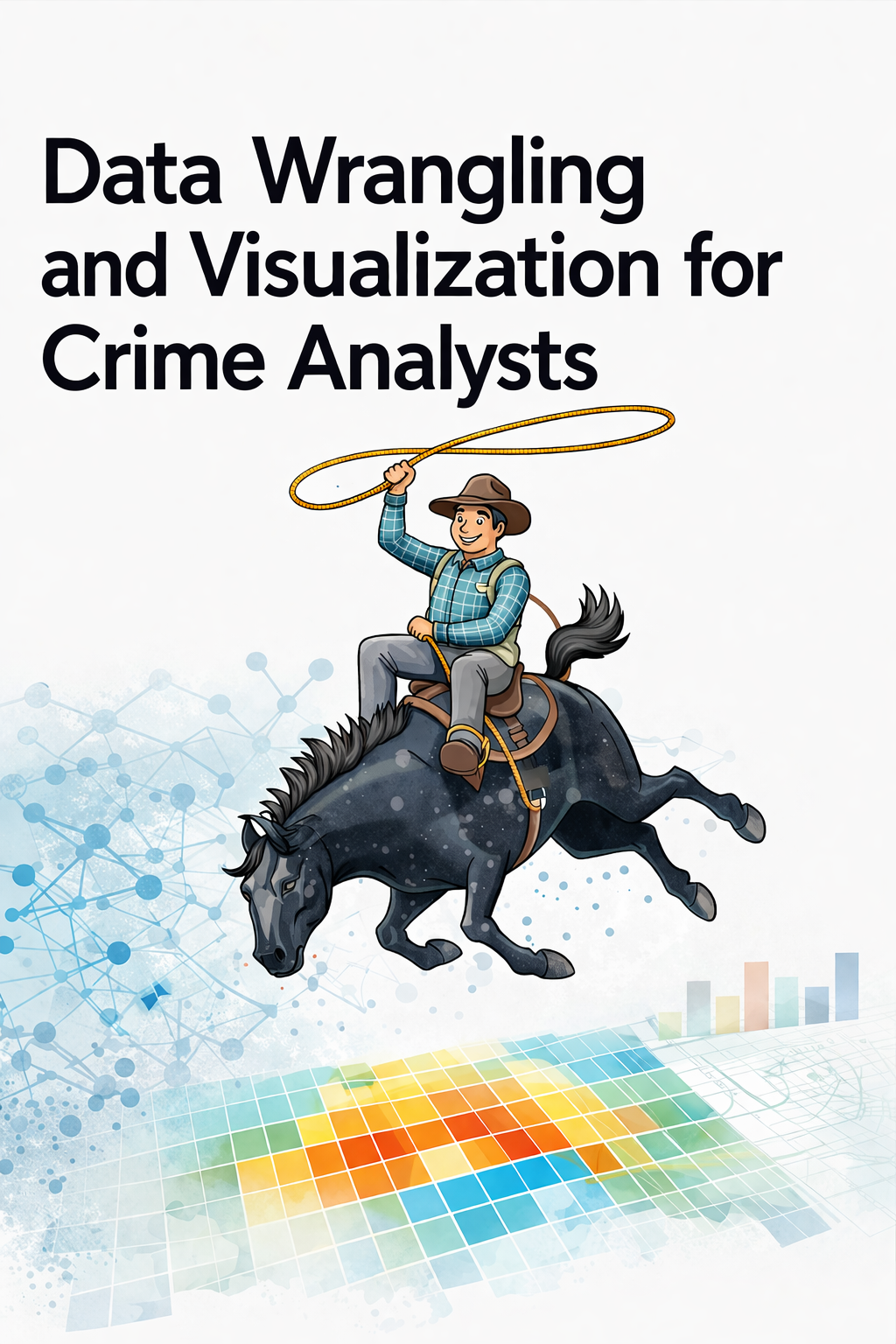
In the last decade, the field of crime analysis has experienced a profound transition. Vast amounts of data are now publicly available: calls for service, incident reports, court records, demographic indicators, mobility data, and more. These open data sources have the potential to deepen our understanding of crime patterns, inform policy, and improve public safety. Yet access alone is not enough as data must be cleaned, interpreted, visualized, and questioned.
Put simply: availability and accessibility are not synonymous.
Data Wrangling and Visualization for Crime Analysts is built with this reality in mind. My goal in writing this text is not just to teach you technical skills. Rather, my goal is to help you develop a way of thinking about accessibility. You will learn how to transform messy, real-world datasets (i.e. data wrangling) into insightful graphics and visual displays (i.e. visualization). These skills are essential tools for any crime analyst.
A key foundation of this work is the set of principles often referred to as open science. In practice, this means your analyses should be transparent, reproducible, and accessible. Others should be able to understand how you arrived at your conclusions, replicate your methods, and build upon your work. In a field that directly shapes public policy and community outcomes, this level of accountability is not just ideal, it is essential.
For crime analysts, open science has particular significance. The decisions informed by your work (e.g. resource allocation, intervention strategies, policy recommendations, and so on) carry real consequences. By adopting open and reproducible practices, you help ensure that those decisions are grounded in evidence that can be scrutinized, improved, and trusted.
At the same time, this book recognizes the realities you will face. Data will be incomplete. Definitions will vary across jurisdictions. Systems will not align cleanly. You will often work under time constraints, with stakeholders who need clear answers. You will build something, then it will break (it happens). This text is designed to prepare you for that environment by emphasizing practical skills: data wrangling, exploratory analysis, and visualization techniques that make complex information understandable and actionable.
You should expect to engage actively with the material. The examples and exercises are drawn from real-world data and reflect the kinds of challenges you will encounter in professional settings. The goal is not simply to teach you how to do something, but to help you understand why it matters and when it is appropriate.
Each chapter in this book will contain R code, which is in “code chunks”. You will notice a code chunk because the font will change. Code chunks will have text that looks like this. R code chunks can be copied and pasted directly into R and RStudio. As you work through the tutorials, follow along in the software by copying and pasting the code and seeing it work on your end.
Ultimately, this book is about building your capacity as a thoughtful, ethical, and effective analyst. If you take one idea from it, let it be this: good analysis is not just about producing results, it is about producing results that others can trust, understand, reproduce, and use.